
DNA tests are a reliable method that analyzes the unique genetic code of the DNA samples to verify the biological family connections. It’s widely utilized by individuals in need to accurately prove genetic links for personal and official needs. A DNA test in India is often used in family disagreements, sponsored immigration cases, and to resolve legal disputes.
Moreover, DNA tests are also widely used by law enforcement for forensic testing to apprehend criminals. Besides, genetic testing is also helpful in diagnosing early medical conditions related to genetic disorders.
The Growing Need for Genetic Testing
People choose genetic testing for different reasons. Some just want to feel sure about their family tree, while others need the results for official use. Because this valuable information is so specific, it provides proof that cannot be argued with in most cases.
1. Personal Peace of Mind
A peace of mind DNA test is performed when the family members have doubts related to their biological connections. It’s a private test solely for personal emotional clarity.
For instance, a father in doubt related to the paternity of his child often undergoes this test to clear the doubts. Moreover, it helps siblings confirm their biological connection, and for adopted children, it helps confirm their genetic link with their birth parents.
2. Official and Legal Requirements
In court-related matters, and sometimes in special cases of an embassy, only an admissible DNA test report is accepted. This process involves a chain of custody procedure, in which the lab expert collects DNA samples under the watch of an official.
Moreover, the official initially verifies the identities of the individuals involved in the test before sample collection. This ensures that only the right parties are present in the sample collection process. This makes the final report legally admissible in embassies or court cases.
- Honorable courts use these reports to decide on child custody or support.
- It’s also used to verify the rightful heir to inherit a family property or asset.
- It can be used to change a name on a birth certificate if the original info was wrong or in case of adoption.
3. DNA Test Results – Confirming Relationships for Immigration
When someone wants to move to a country like the UK, the USA, or Australia to be with their family, they often apply for a sponsored visa. However, the paperwork of the visa application is sometimes not enough for the embassy to verify the sponsor-applicant’s family ties. In such cases, a DNA test provides concrete evidence for further validation. By such a procedure, immigration authorities ensure that only real family members are allowed to join their sponsors abroad.
4. Ancestry DNA Test
Individuals interested in finding their ancestral past often go after this test to have their paternal and maternal lineage analyzed. Moreover, it also demonstrates the location of where the ancestors lived, along with their migration patterns throughout the centuries.
Medical and Research Applications
A DNA test is a powerful tool that also plays a vital role in the field of medical science, such as:
5. Rule for Organ Transplants
In many hospitals, organ transplants are a common procedure, but they must follow strict rules. According to the Indian law known as the THOA 2014, it is mandatory to have a genetic test. This test proves that the person giving the organ is truly related to the person receiving it. This is done to prevent the illegal trade of human organs and to keep patients safe.
6. Cell Line Authentication for Researchers
Researchers who work in labs often study different types of cells to find cures for diseases. They need to be 100% sure that the cells they are using are correctly identified. This process of verifying the cell lines is called cell line authentication. It helps lab researchers make sure that their research is accurate and that the medicines or vaccines they create will be safe for people to use.
7. Carrier Screening Tests for Inherited Conditions
Disease vulnerabilities, like physical traits, can be inherited, making individuals potential carriers of disease-causing genes.
A family history of genetic or other diseases increases the likelihood of carrying those genes.
Gene carrier screening and DNA testing help identify risks early and enable informed, timely preventive action.
Explore the Different Categories of DNA Tests
There are several DNA testing services to meet the diverse needs of individuals. Each one provides insights related to a specific kind of family connection. Understanding which one to choose is the first step toward getting the right answers..
- Paternity Test: This is used to establish the link between an alleged father and a child.
- Maternity Testing: This verifies the biological bond between a mother and her child.
- Siblingship: This determines if two or more people are full or half-related through their genes.
- Grandparentage Testing: This links a grandparent to their grandchild, which is often used when the parents are not available.
- Avuncular: This establishes a family link between an uncle/aunt and their nephew or niece.
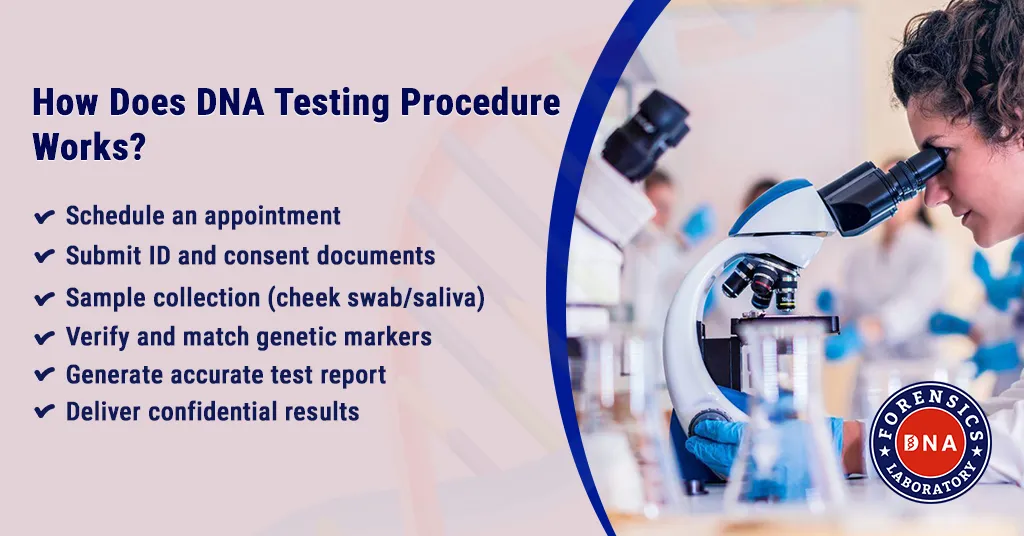
How the Testing Procedure Works
The process of getting a test is designed to be very simple and comfortable for everyone involved.
Scheduling the Test – First, the interested parties book an appointment at a lab to have their DNA samples collected.
Sample Collection – A lab expert collects the DNA samples from the individuals using a cotton swab method. It’s a painless and safe procedure, which collects only a saliva sample from the mouth.
Lab Analysis – The samples are then sent to a lab for further analysis, where the experts examine and compare them to find the genetic match.
A Final Report – A final report is generated on the basis of the DNA examination. This report is then securely sent to the tested party’s address.
However, in a chain of custody procedure, the final report is sent directly to the officials who requested the test. It’s to maintain the integrity and confidentiality of the report.
Understanding the Genetic Markers
You might wonder how a lab can tell if two people are related just by looking at their cheek cells. Scientists look at special parts of the DNA called markers. This genetic makeup has repeating DNA sequences that are passed down from parents to children.
- If the patterns between two people match closely, they are biologically related.
- If the patterns are completely different, the lab will state that there is no biological relationship.
- Modern labs use advanced tools to check genetic information for the best accuracy.
Why is Privacy a Priority in a DNA Test?
When dealing with such personal information, keeping things secret is very important. Reputable labs make sure that the results are only shared with the person who asked for the test. They use secure systems to store data so that no one else can see it.
For legal purposes, the privacy rules are even stricter. The final report is often sent directly to the judge’s office instead of the person being tested. This prevents anyone from trying to change the results and keeps the whole process fair for everyone involved.
DNA Forensics Laboratory – Your Trustworthy Partner for DNA Tests in India
DNA Forensics Laboratory, also called DFL, is one of the high-quality forensic DNA testing Labs in India for the best test results. A good lab will have official recognitions, which are called accreditations. These approvals mean that the lab follows international rules for accuracy and honesty.
Certifications of DFL:
When a lab has certifications, its reports are more likely to be accepted by the honorable courts and embassies. Without these, a person might waste their time and money on a report that is not admissible for official use cases.
- NABL: Our DNA and forensics testing laboratory – CTRF is accredited by NABL
- ISO 15189:2012: This is an international standard for medical labs.
- ILAC MRA: This helps the lab’s reports be recognized in other countries.
- AABB: This is a very respected certification for relationship testing.
- Ministry of Justice (MOJ): This is important for legal matters involving the UK.
Services Availed Direct to Consumer
Individuals in need of a DNA test for either personal or official matters can contact the experts of DNA Forensics Pvt. Ltd. The experts assist in booking the test, choosing the convenient sample collection method, and getting results directly into their email inbox, without requiring any formalities or a middleman.
Frequently Asked Questions
Q1. What is the DNA procedure for a DNA test in India?
Initially, the interested party books their appointment at the lab for the sample collection. Then the samples from the individuals are collected by a lab expert. A lab expert then analyzes and compares the DNA samples.
Q2. How to take an Ancestry test in India?
First, you need to visit the lab for DNA sample collection. Then, the collected sample will be compared with the existing huge genetic data of DNA profiles. Upon the DNA match, the test result will display the family history along with the ancestors’ migration patterns.
Q3. What is the cost of DNA tests in India?
A DNA test doesn’t have a fixed price. Instead, it fluctuates based on different factors, such as the number of people in the test, the purpose of the test, and the express delivery of the report.
Q4. Is taking DNA tests legal in India?
Absolutely. DNA tests are completely legal in India. Such tests can be performed for personal or legal reasons.
Q5. Can DNA tests be done privately in India?
Yes. A peace of mind DNA test offers complete privacy of the test, as it’s done solely for the purpose of clearing doubts related to biological family connections.
Q6. Is the Ancestry DNA test accurate for Indians?
Yes. An ancestry DNA test provides 99.99% accurate test results.
Q7. Can DNA tests confirm a biological father?
Certainly! A paternity test can confirm the father-child biological link for legal as well as personal needs. Moreover, for prenatal testing, a non-invasive procedure is utilized.

