
You are likely looking for the best way to move abroad and join your loved ones. The visa process can feel overwhelming when you have to provide so much evidence to the authorities. While you might have papers ready, embassies often look for much deeper proof of your biological relationships.
Using a professional immigration DNA test can be the key to proving your genetic relationship with your sponsor with complete certainty. A DNA test report removes all doubt from your application and helps you avoid common delays.
Why Standard Documents Might Not Be Enough
When you apply for a family-based visa, immigration officers check your documents very carefully. They want to make sure that everyone entering the country is truly related to their sponsor to prevent fraudulent applications. Often, standard papers like birth certificates might not be enough for the officials.
You might need to use immigration DNA tests in India if your case involves:
- Missing Paperwork: If you do not have a birth certificate or other official records.
- Document Doubts: If the embassy thinks your existing documents might not be authentic or were issued many years after birth.
- Name Differences: When the surnames of the sponsor and the applicant do not match.
- Appearance Changes: If your facial appearance in your passport looks very different from your visa application.
- Special Cases: Situations involving adoption or a history of previous visa rejections often require DNA proof.
Proving Different Family Ties
Genetic testing is not just for parents and children; it can prove many different family connections. Whether you are moving to be with a parent or a sibling, the process is very similar. The most common relationships verified include:
- Paternity: This confirms the biological link between a father and a child.
- Maternity: This validates the genetic connection between a mother and a child.
- Siblingship: This is used to prove that two or more people share the same parents.
- Grandparentage: This shows the link between a grandparent and their grandchild.
- Kinship (Avuncular): This test confirms the relationship between an uncle/aunt and their niece or nephew.
By using scientific evidence, you can clear up any doubts and show the undeniable truth about your family ties.
The Step-by-Step Testing Process
The process of DNA testing for immigration purposes is simple and painless for everyone involved. Here is how it usually works:
1. Scheduling and Coordination
First, you schedule an appointment at a lab for DNA collection. If you and your sponsor are living in different countries, a professional lab can coordinate the test across borders so you can complete the requirements even when you are miles apart.
2. Simple Sample Collection
A lab expert will use a sterile cotton swab to rub the inside of your cheek for a few seconds. This collects tiny skin cells that contain your genetic code. Because it is non-invasive, the test is safe for everyone, from tiny babies to elderly family members.
3. Lab Analysis
The collected samples are securely sealed and sent to a lab. Experts look at specific parts of your DNA called “markers.” These are unique patterns passed down from parents to children. By comparing these markers, experts can determine if a biological relationship exists with certainty.
4. Getting Your Results
After finishing the analysis, a final report is generated. This report is then confidentially sent to your address. However, if the test was done under a chain of custody procedure, the report is sent directly to the embassy.
Understanding the Chain of Custody
In some cases, the embassy will ask for a special process called “chain of custody.” This is a formal way of handling samples to ensure no one can tamper with them.
- Supervision: An official monitors the entire DNA collection and sealing of the samples to ensure everything is legal and honest.
- Identification: The official verifies the identities of everyone in the test using government-issued IDs.
- Direct Delivery: The final report is usually sent directly to the embassy instead of your home to maintain strict confidentiality.
While this process costs more and takes extra time due to the paperwork, it is often mandatory if the embassy requests it.
Benefits of Providing a DNA Test Report with Visa Documents
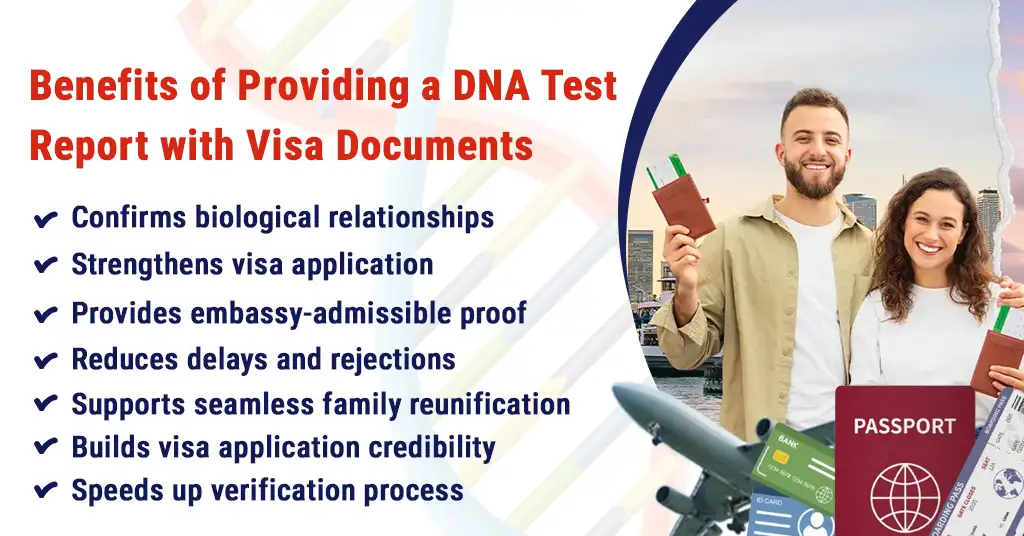
You do not always have to wait for the embassy to ask for a test. Submitting a DNA report along with your initial visa documents can be very helpful.
- Speeding Up the Process: It prevents delays that happen when the embassy has to stop and ask for more proof.
- Increasing Legitimacy: It shows that your application is honest and backed by scientific evidence from the start.
- Providing Peace of Mind: You can feel more confident knowing your family link is already proven, which reduces the risk of visa refusal.
Cost and Turnaround Times
The price for a DNA test is not the same for everyone because several factors change the final amount.
- Purpose: A test for immigration costs more than a “peace of mind” test because of the “chain of custody” rules and extra documentation.
- Number of Participants: The cost goes up if more people need to be tested, such as a father sponsoring multiple children.
Essential Documents for Your Appointment
When you go for your DNA collection, you must bring specific items to ensure the process is valid for immigration:
- Passport: This is mandatory for an immigration-related test.
- Government-issued ID: To verify your identity.
- Photographs: Two recent passport-sized photographs.
- Consent Form: This is usually provided by the lab at the time of your appointment.
Why Choose DNA Forensics Laboratory Pvt. Ltd.?
For sponsored immigration cases, embassies accept DNA test reports only from accredited laboratories — with recognized accreditations including NATA, NABL, MOJ, IRCC, and AABB, applicable across countries such as the United States, the United Kingdom, Canada, Australia, and others. Our DNA and forensics testing laboratory, Chimera Transplant Research Foundation, holds NABL accreditation and is ISO-certified, ensuring that all test procedures are carried out to the highest quality standards — making our reports fully eligible for submission in sponsored immigration cases.
DNA Forensics Laboratory, in partnership with DDC Laboratories India, provides accredited DNA test reports that are admissible in international embassies. This makes us one of the most reliable labs for immigration DNA tests.
Besides, the DNA Forensics Laboratory, also called DFL, is the only private DNA testing company in India whose DNA test reports are legally admissible in the honorable courts of law.
Taking the Next Step Toward Reunification
Providing scientific proof is the best way to handle any questions the embassy might have about your family. By following these steps and working with an accredited lab, you can move closer to reuniting with your loved ones abroad. Using an immigration DNA test allows you to provide a clear answer that cannot be argued with, making your application much stronger in the eyes of the officials.
For more information or to book your test, you can call the experts at +91 8010177771 or send a message on WhatsApp at +91 9266615552.
Frequently Asked Questions
Q1. How long does it take to get DNA test results for immigration?
Typically, it takes around 5-10 business days to receive the final report from the immigration DNA test.
Q2. How to book an immigration DNA test appointment in India?
Call the experts of the DNA Forensics Laboratory and tell them about your requirements. They’ll schedule an appointment for the DNA sample collection.
Q3. What is the process for an immigration DNA test?
Initially, a lab expert collects the DNA samples from the interested party. Then, the samples are securely sealed and sent to a lab for further analysis. In the lab, experts examine and compare the DNA samples to find the potential genetic match.
Q4. How much do immigration DNA tests cost in India?
The cost of an immigration DNA test is usually around 42,000 INR. However, this cost can vary depending on how many individuals are involved in the test. The more people in a DNA test, the higher its cost will be.
Q5. Which labs in India provide accredited immigration DNA tests?
DNA Forensics Laboratory, in partnership with DDC Laboratories India, fulfills the accredited immigration DNA testing needs for embassy-admissible DNA test reports.

