
Imagine you have spent two years studying a specific type of cancer in your lab. You have used all your funding and worked late nights to find a breakthrough that could save lives. Suddenly, you find out the cells you were using were actually skin cells, not cancer cells.
All your data is now useless, and your report cannot be published. This nightmare happens to many researchers who skip the step of cell line authentication. It is the only way to be sure about what you are studying.
The Hidden Threats to Your Research Accuracy
Cells are living units that can change or get mixed up very easily. There are three main problems that can ruin your project if you are not careful.
Misidentification of Cells
This happens when a cell line is labeled incorrectly from the very start. You might receive a vial from another lab, thinking it contains one type of cell, but it is actually a misidentified cell line. Without a check, you could spend your entire career working on the wrong material.
The Problem of Genetic Drift
Cells divide and grow over time. If you store them for a long time, their genetic code can slowly change. Eventually, they lose their original cell line identity and become a completely different type of cell.
Cross-Contamination
Cross-contaminated cell lines are a very common issue in bustling laboratories. It happens when a small amount of one cell line accidentally gets into another container. Because some cells grow faster than others, they can take over the whole sample without you noticing.
How the Cell Line Authentication Process Works
To keep your research accurate, you need to use a reliable testing process. This process follows five specific steps to give you a clear answer.
- Careful Sample Collection – The first step is taking a tiny portion of the cells you are currently growing. You must do this with extreme care so that no bacteria or environmental contaminants get into the sample. Once the sample is taken, it is sealed securely for the lab to examine.
- Extracting the DNA – In the lab, experts use special chemicals to break open the cells. This allows them to pull out the DNA, which holds the unique code of that cell line. The DNA is then purified so that the chemicals do not interfere with the next steps.
- DNA Amplification (PCR) – Sometimes the amount of DNA is too small to see clearly. Lab experts use a method called Polymerase Chain Reaction, or PCR, to make millions of copies of specific areas. They focus on Short Tandem Repeats (STRs), which are sequences that repeat themselves in the DNA. These repeats are different for every single cell line.
- Creating a Genetic Profile – Once the DNA is copied, computers help the experts read the patterns. The result is a genetic profile that shows a series of peaks on a graph. This profile acts as a unique ID card for the cells you are using.
- Comparison and Final Results – Finally, your cell’s profile is compared against a massive database of known, verified cell lines. If the profiles match perfectly, your cells are confirmed as authentic. If there is no match, it is a warning that your sample has been contaminated or has changed over time.
Why Major Journals and Funding Groups Require Proof
In the past, many researchers did not check their cells, which led to a crisis in science. Thousands of papers had to be canceled because the data was not real. Today, the rules are much stricter.
Most high-quality scientific journals now demand proof of cell line authentication before they will even look at your work. Groups like the National Institutes of Health (NIH) also have strict guidelines. They want to make sure the money they give you is being used on valid experiments. If you cannot prove your cells are correct, you may lose your funding and your chance to publish.
Protecting Lab Budget & Reputation
Research is very expensive. You have to pay for high-tech equipment, specialized chemicals, and the time of many smart people. If you find out at the end of a project that your cells were wrong, all that money is wasted.
It is much more affordable to test your samples once or twice a year than to lose an entire project. Beyond the money, your reputation is at stake. Researchers around the world need to trust your data so they can build on your discoveries. Using authenticated cells ensures that your name stays respected in the scientific community.
When Should You Test Your Cells?
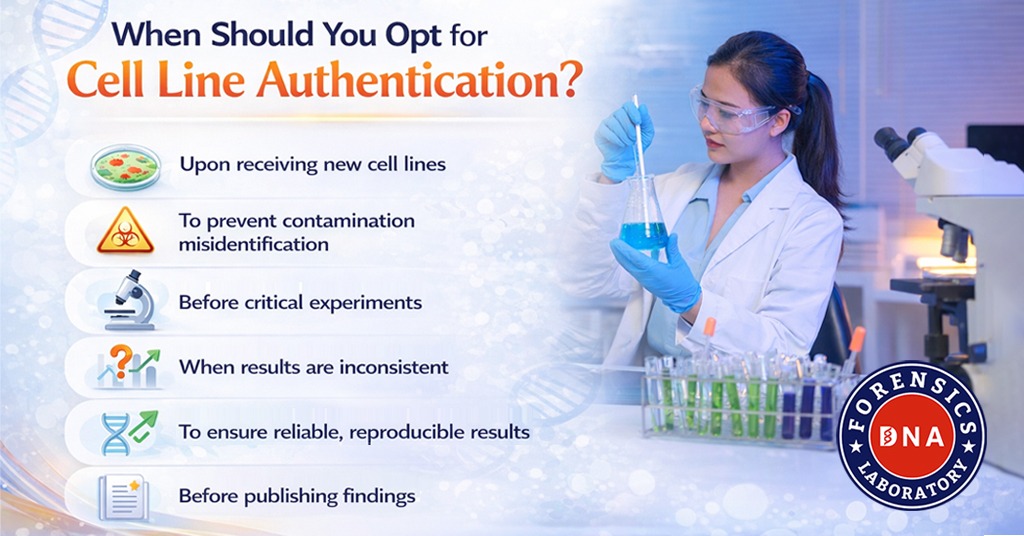
You should not wait until the end of your project to perform a check. To keep your work accurate, you should authenticate your cell lines at these specific times:
- Upon Discovery of a New Cell Line: Even if it comes from a trusted friend or another lab, you must check it immediately.
- Before Starting a New Project: This saves you from wasting months of time on the wrong material.
- During the Growth Process: As cells divide, they can change, so regular checks are important.
- Before Storing Cell Lines: You want to be sure the cells you put in the freezer are correctly identified for future use.
- Before Publishing Journal: Journals will ask for the most recent proof of authenticity.
DNA Forensics Laboratory – Your Trustworthy Partner for Cell Line Authentication
When you decide to authenticate your cells, you must choose a lab that follows the highest international standards. You need a team that uses cutting-edge technology and has many years of experience. Accuracy is the most important part of this process.
DNA Forensics Laboratory, also called DFL, is a trusted choice for these procedures. We are known for providing fast and accurate reports so you can get back to your experiments quickly. Besides, our lab experts are also available to help you understand what your results mean for your specific study.
Keeping Your Data Safe
Privacy is also a major concern when you are working on new discoveries. You need to be sure that your research data is in safe hands. Professional labs have strict protocols to keep your information confidential. They only share results with the people directly involved in the testing process.
Using the wrong cells can ruin years of effort and lead to dangerous results. By making this test a regular part of your lab schedule, you protect your career and help the world find real cures for diseases. It is a simple step that makes a huge difference in the quality of your research. For any researcher, finding a trusted provider for cell line authentication in India is the best way to ensure that your hard work leads to real, lasting success.
For more information or to book a cell line authentication service, call us at +91 8010177771. Alternatively, you can also send a message on WhatsApp at +91 9266615552.
Frequently Asked Questions
Q1. What does it mean to authenticate a cell line?
The process of authenticating a cell line is about finding the true identity of the cell lines to ensure that they are what they are claimed to be.
Q2. Where to find accredited cell line testing labs in India?
The DNA Forensics Laboratory is one of the most trustworthy labs for cell line authentication tests in India. You can call our experts and schedule an appointment for authenticating a cell line of interest.
Q3. How long does cell line authentication testing usually take?
A cell line authentication process usually takes around 10-15 days, as it compares the DNA profile with an existing huge database of other DNA profiles.
Q4. What type of problems can occur if research is done without authenticating the cell lines?
Without authenticating a cell line, the research can be wrong, as cell lines tend to get easily contaminated or mixed with other cell lines. Moreover, in some cases, the cell lines are wrongly labelled.
Q5. Is the cell line authentication process confidential at DNA Forensics Laboratory?
Yes. DNA Forensics Laboratory keeps all the information confidential. The information is shared only with the authorized parties. No third-party individual can access this information.
Q6. Can I get a certificate for cell line authentication?
Absolutely. DNA Forensics Laboratory provides a certification of cell line authentication, which researchers can utilize to demonstrate the accuracy, reliability, and authenticity of their research work.

