
Immigration DNA tests become crucial when the embassies ask applicants for concrete evidence to prove their family ties with their sponsors. Initially, the UK immigration authorities rely on the submitted visa documents to validate the sponsor-applicant’s biological relationship. But in some cases, such documents are rejected by the embassies due to suspicion.
When this happens, the embassy asks for admissible evidence of a DNA test for UK immigration. A DNA testing process provides reliable evidence of the family ties, which is widely accepted by international embassies.
Why Do Embassies Ask for a DNA Test Report?
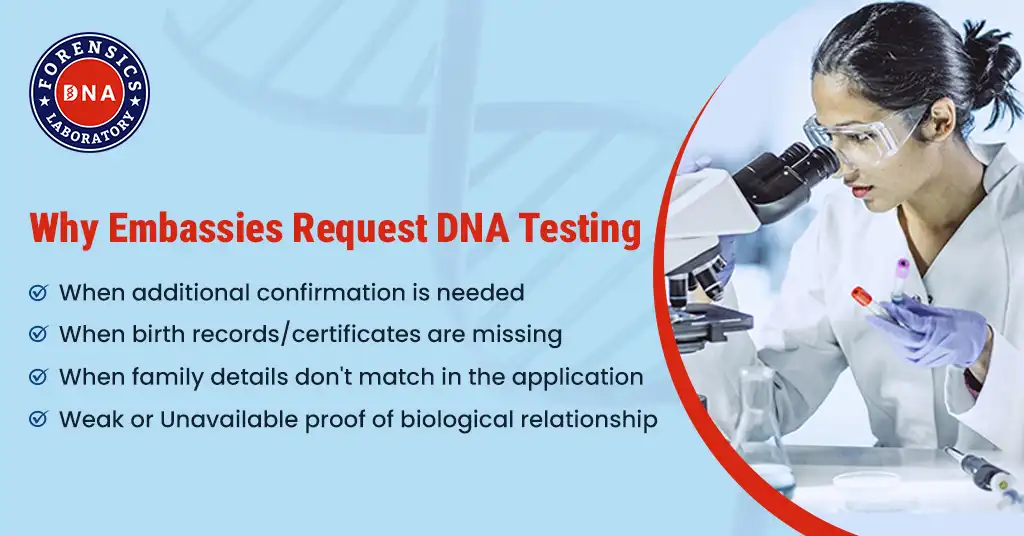
As the submitted visa documents fail to establish the biological link between the sponsor and applicant, the embassy may demand a DNA test report.
Immigration authorities utilize strict metrics to grant sponsored visa applications. The following reasons are more common behind the suspicion of a visa application:
- Despite the biological connection, the sponsor and applicant have different surnames.
- The applicant has different photographs on the visa application and the passport.
- Missing or incomplete visa documents.
- Prior history of visa rejection.
Types of Family Links in a Sponsored Immigration
The following family ties are involved in the DNA test for immigration in UK:
Paternity – It involves the verification of the father-child biological link.
Maternity – This test validates the genetic link between a mother and a child.
Siblingship – The family ties between the siblings are often confirmed using an immigration DNA analysis.
Grandparentage – It validates the family link between a grandparent and a grandchild.
Avuncular – This test authenticates the family ties of an uncle/aunt with their niece/nephew.
Understanding the DNA Test Procedure
DNA tests for the UK Visa are performed using the following easy steps:
1. Scheduling the Appointment
Initially, the sponsor and the applicant schedule an appointment at a lab for the DNA test. If both are living in different countries at the time of testing, the same lab coordinates the test accordingly.
2. DNA Collection
The DNA samples from the sponsor and applicant are collected by a lab expert using a cheek swab method. The cotton swabs are rubbed against the inside of the cheek walls to obtain the epithelial cells. It’s a safe, non-invasive, and painless procedure for individuals of all ages.
3. Lab Examination
The DNA samples are later securely sealed to avoid tampering and contamination and sent to a lab for further testing. The experts in the lab then perform DNA analysis and compare the samples to find the potential genetic match between the tested individuals.
4. The Final Report
After finishing the examination of the DNA samples, a final report is generated, which states whether a biological relationship exists. This report is then confidentially sent to the tested party’s address.
Chain of Custody Procedure in Sponsored Immigration
In special cases, the embassy may demand a DNA test under a strict chain of custody procedure. In this process, the DNA samples from the sponsor and applicant are collected under the supervision of an embassy official.
Until the samples are securely sealed, the official continues to monitor the process. The final report of this test is directly sent to the embassy that requested the test. In this case, the final report isn’t sent to the tested party to maintain the privacy and integrity of the report.
How Much Do Immigration DNA Tests Cost?
The cost of a DNA test for immigration in UK isn’t fixed to a single metric. Instead, several metrics are considered before finalizing the cost of the immigration DNA test. Such metrics are:
1. Number of Individuals Involved – As the number of people increases in a DNA test, its cost also increases. For example, a usual immigration is between two individuals. But when an additional family member is involved in the family reunification.
2. Express Delivery of the Report – Individuals in need of an urgent report can choose this option at an additional cost. It delivers the final report within 24-48 hours of testing. The typical time for the report delivery is 4-5 business days.
How Do Experts Find the Genetic Match Using DNA Samples?
The analysis of the DNA samples is based on the DNA markers, which are the repeating sequences within the DNA. The pattern of these repeating sequences is unique for each individual.
This pattern is found to be similar only in two biologically related bodies. Therefore, when experts analyze the DNA, they look specifically at such DNA markers. If the pattern matches, the biological relationship is established. However, if there’s no match found, then the genetic link is rejected with certainty.
Why Choose DNA Forensics Laboratory for Sponsored Immigration DNA Tests?
For sponsored immigration, the DNA Forensics Laboratory Pvt. Ltd. holds accreditations from organizations such as NABL, NATA, CIC, MOJ, and AABB. International embassies like the United States, the United Kingdom, Canada, Australia, and other countries accept only accredited DNA test reports. This makes the DNA Forensics Laboratory a reliable lab for the best DNA test for immigration in the UK that provides accurate DNA test results.
Moreover, the DNA Forensics Laboratory is the only private DNA testing company in India whose DNA test reports are legally admissible in the honorable courts of law. This makes us a highly qualified lab for an immigration DNA test. Besides, we also offer DNA evidence for peace of mind, legal disputes, and ancestry tests.
Frequently Asked Questions
Q1. Is a DNA test required for the UK Visa?
Yes. It’s crucial to submit a DNA test report for a UK visa application. In case the embassy suspects the visa documents, the immigration DNA test report strongly proves the sponsor-applicant’s family ties.
Q2. How much does a DNA test cost for Immigration?
The cost of a DNA test is around 45,000 INR. However, this cost can vary depending on factors such as the number of individuals involved or the express delivery of the report.
Q3. Do immigration authorities ask for a DNA test?
Absolutely. When the submitted visa documents fail to prove the sponsor-applicant’s family ties, the authorities may ask for a DNA test report.
Q4. Which DNA test is best for the UK immigration?
An accredited DNA test is the first and foremost choice for immigration in the UK. A lab with Ministry of Justice (MOJ) accreditation is considered reliable for the UK immigration.
Q5. What is the most common mistake in the UK visa application?
Applicants often ignore submitting a DNA test report. In case the primary documents fail to prove the sponsor-applicant’s family ties, a DNA test report is the only reliable option. However, if the documents do not contain a DNA test report, then the embassy may reject the visa application.
Q6. How long do immigration DNA tests take?
Immigration DNA analysis is usually done in a few minutes, as only the cheek swab samples are obtained from the sponsor and the applicant. However, the final report takes around 4-5 business days, which can be expedited at additional cost to 24-48 hours.

