

Organ transplantation is a vital medical advancement that helps save thousands of lives every year by replacing failing organs with healthy ones. This procedure involves moving an organ from a donor, who can be living or deceased, to a patient in need of a healthy replacement. Because this is a major surgery, hospitals and doctors must follow very strict rules to ensure the safety and health of everyone involved.
One of the most important tools used to maintain these standards is organ transplant DNA tests in India. This verification helps confirm that the process is legal and that the donor and recipient are actually related.
The Legal Framework for Organ Donation
India has established very strict laws to protect patients and donors from illegal activities. The main law governing these procedures is the Transplantation of Human Organs Act (THOA), passed in 2014. This act was created to stop the illegal buying and selling of human organs and to ensure all donations are made for the right reasons. Under this law, it is illegal for someone to sell their organs for money.
The law focuses heavily on “living donors,” which are people who choose to donate an organ or part of an organ while they are still alive. To prevent fraud, the THOA 2014 states that a living person can generally only donate an organ to a close relative. This list of close relatives includes:
- Parents (mother or father).
- Children (son or daughter).
- Siblings (brother or sister).
- Spouse (husband or wife).
- Other specific family members, like grandparents or grandchildren.
Why is DNA Testing Necessary?
In the past, some individuals tried to bypass the law by using fake documents to pretend they were related to a patient. These people might have been part of illegal trafficking networks or were looking for financial gain. Because paper documents like birth certificates can sometimes be forged, the government requires a more certain method of proof.
A DNA test provides this certainty because a person’s genetic code cannot be faked. By comparing the genetic markers of the donor and the patient, lab experts can prove beyond a doubt if they are biologically related.
The Role of the Authorization Committee
Every hospital that performs organ transplants must work with a group known as the Organ Transplant Approval Committee. This committee acts as a gatekeeper to ensure every surgery follows the law. Before any surgery can happen, the committee must review all the paperwork and evidence for the case. They look at medical records, identity documents, and proof of relationship.
One of the most critical pieces of evidence they look for is the DNA test report. This report must be presented in a specific legal format, which is usually referred to as “Form 5”. If the DNA report is not from an accredited laboratory, the committee will not give permission for the transplant procedure to move forward. This strict process ensures that the relationship is genuine and that no illegal organ trading is taking place.
Understanding Liver Transplants & Genetic Proof
The liver is a unique organ because it has the amazing ability to grow back, or “regenerate”. Because of this, a healthy living person can donate a portion of their liver to someone whose liver is failing. After the surgery, the remaining part of the donor’s liver grows back to its full size, and the donated part in the patient also grows to a full-sized, functioning liver within a few weeks.
While this is a life-saving option, it is also a very urgent procedure because liver failure is often more fatal and does not have a long-term treatment like dialysis. Because the law is so strict, a DNA test for liver transplant is a mandatory step in the process. It serves as the final proof needed by the hospital and the legal authorities to confirm that the donor is a real family member. This testing ensures that the donation is voluntary and follows all ethical guidelines.
The Importance of DNA Evidence in Kidney Transplants
Kidney failure is one of the most common reasons people need an organ transplant today. When a person’s kidneys stop working, they often have to go through dialysis, which is a process that cleans their blood. However, a transplant is usually the best long-term solution for a healthy life.
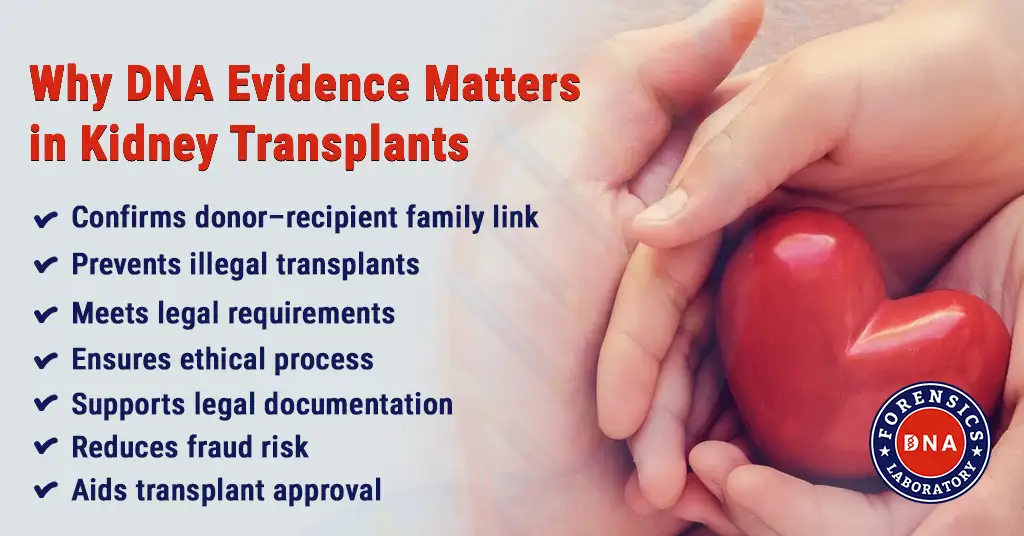
Because kidney failure can become a medical emergency, finding a donor quickly is important. Most of the time, family members are the first choice for a donor because they are often the best genetic match. Just like with other organs, a DNA test for kidney transplant is required by law to verify the family link. This test not only fulfills the legal requirements of the THOA but also helps the surgical team understand the compatibility between the two people.
Medical Benefits of Genetic Testing
While the main reason for these tests is to follow the law, there are also medical reasons why DNA testing is helpful for the patient and the doctors.
- Confirming Compatibility: DNA testing helps doctors see how closely related the donor and recipient are.
- Reducing Rejection Risk: When a donor and patient are close genetic relatives, there is a lower chance that the patient’s body will reject the new organ.
- Ensuring Long-Term Success: A closer genetic match can lead to a more successful transplant that lasts for many years.
- Speeding Up Approval: Having a clear, accurate DNA report helps the Authorization Committee make its decision faster, which means the patient can get their surgery sooner.
How the DNA Testing Process Works
The process of getting a DNA test is designed to be simple and as comfortable as possible for both the donor and the patient. It generally follows these steps:
- Booking the Test: The family schedules an appointment with a laboratory that is accredited and experienced in organ transplant cases.
- Sample Collection: A professional collector takes samples from both the donor and the recipient. This is usually done using a “cheek swab” (a buccal swab) to collect cells from the inside of the mouth, or by taking a small blood sample. Both methods are quick and not painful.
- Lab Analysis: The samples are sent to a high-tech laboratory where scientists look at specific genetic markers.
- Comparing Results: The lab compares the DNA from both people to see if they share the markers that prove a biological relationship.
- Issuing the Report: Once the analysis is complete, the lab creates an official report stating whether the family link exists.
- Direct Delivery: To make sure the DNA test results are not changed or tampered with, the lab sends the report directly to the hospital or the Authorization Committee.
Why Choose DNA Forensics Laboratory Pvt. Ltd. for Organ Transplant DNA Test?
Choosing the right laboratory is one of the most important parts of the organ transplant process. The law requires that the lab be NABL-accredited. This accreditation means the lab meets very high standards for accuracy and quality.
DNA Forensics Laboratory, also called DFL, is a well-known and trusted partner for these types of tests. We hold many important certifications, including NABL, ISO 15189:2022, and AABB. We also provide reports that are legally admissible and accepted by the Authorization Committees and courts across the country. Using a professional lab ensures that the privacy and confidentiality of the patient and donor are always protected. By following these strict steps and using reliable organ transplant DNA tests in India, families can move forward with life-saving surgeries with confidence and peace of mind.
Frequently Asked Questions
Q1. How do organ transplant DNA tests work?
Such tests work by analyzing the genetic markers of the living donor and the recipient. When the markers match, individuals are said to be family related.
Q2. What is the role of genetic relationship testing in organ donation verification?
This test verifies whether the living donor and the recipient are truly biologically related. It ensures the transparency and safety of individuals.
Q3. How to book a DNA test for an organ transplant?
You can call the experts of the DNA Forensics Laboratory Pvt. Ltd. at +91 8010177771 and schedule an appointment for your organ transplant DNA test.
Q4. How long does a DNA test for a kidney transplant take to process in India?
A kidney transplant DNA test takes around 4-7 business days. However, it can take up to two weeks, depending on the complexity and the legal requirements of the transplant committee.
Q5. What is the cost of an organ transplant DNA test?
The cost of an organ transplant DNA test is around 25,000 INR at DNA Forensics Laboratory.

