

Finding out the truth about a child’s biological father is something many families go through. Whether it’s a personal matter weighing on your mind or a formal requirement from a court or embassy, you deserve clear and reliable answers. You may have questions about how the process works, what it costs, or whether it’s even allowed by law. A paternity test in India gives you the accurate and reliable answers you need.
About Paternity DNA Test
A paternity DNA test is a procedure that checks whether a man is the biological father of a child. It does this by comparing specific patterns in the DNA of both individuals.
Every child receives 50% of their DNA from their mother and 50% from their father. Lab experts analyze the unique markers, which are the repeating patterns found across several regions of the DNA. These markers are passed down from parent to child. If the markers from the alleged father match those of the child, the biological link is confirmed. If they do not match, the relationship is ruled out.
The result of this test is 99.99% accurate, which makes it acceptable for both personal and official purposes.
Understanding the Need for Paternity Tests
There are several reasons why you might consider getting a paternity test. Here are the most common ones:
- Personal Peace of Mind – This is the most common reason families choose to go through this process. If there’s any doubt in the family about who the biological father is, a test can provide the emotional clarity needed to move forward. There are no extra formalities involved in this type of test.
- Legal Disputes – Courts in India may require biological evidence to settle matters such as:
- Child custody and financial support – Judges use DNA evidence to make fair decisions about a child’s care and who provides for them financially.
- Inheritance and property claims – If someone’s right to a family asset is being questioned, a DNA test can confirm whether they are a rightful heir.
- Updating the father’s name on a birth certificate – An adopted child who has reconnected with their biological father can request an official name change on their birth certificate. A court-admissible DNA report is required for this.
- Sponsored Immigration – When a father is sponsoring his child’s visa application, the embassy may ask for DNA proof. This usually happens when the primary visa documents fail to prove the family ties.
How Does the Paternity DNA Testing Process Work?
Getting a paternity DNA test is a lot simpler than most people expect. Here’s what the process looks like, step by step:
Step 1 – Sample Collection: A trained lab expert uses a buccal swab, which is basically a soft cotton bud. They gently rub it on the inside of your cheek to collect skin cells. This is completely painless and takes only a few seconds. The procedure is safe for people of all ages, including newborn babies.
Step 2 – Secure Packaging & Transportation: Once collected, the samples are sealed in a tamper-proof package to prevent any contamination. They are then securely sent to the laboratory.
Step 3 – Lab Analysis: Experts at the lab carefully examine and compare the DNA samples. They look for genetic marker matches between the child and the alleged father.
Step 4 – Final Report: After the analysis is done, a final report is prepared. For personal tests, it is sent directly to your address. For legal or embassy cases, the report is sent to the requesting official’s office.
The Chain of Custody Procedure in Official DNA Tests
If you need a court-admissible result, the test must follow what is called a chain of custody procedure. This is a strict set of rules designed to make the results legally valid and trustworthy.
Here’s how it works:
- Identity verification – Before the DNA samples are collected, a court-appointed representative checks the government-issued IDs of everyone involved in the test.
- Supervised collection – The DNA samples are collected in the presence of an official.
- Tamper-proof sealing – The samples are sealed securely to ensure no one can tamper with them.
- Direct delivery of the report – The final report is sent straight to the honorable hearing judge’s office or the requesting embassy. It is not sent to the tested individuals to protect the privacy of the report for its official admissibility.
Factors Affecting the Paternity DNA Test Cost in India
There is no single fixed price for a DNA test. The paternity DNA test cost in India varies depending on the following factors:
Factor 1 – Type of test: A personal peace of mind test is more affordable since it doesn’t involve official paperwork. A legal or immigration test costs more because it requires additional documentation and a chain of custody procedure.
Factor 2 – Number of people: The standard cost covers one father and one child. Adding more individuals, such as an additional child, can significantly increase the cost.
Factor 3 – Specialized tests: A non-invasive prenatal paternity test requires advanced analysis, which makes it more expensive than a standard test.
Factor 4 – Express delivery: If you need your results faster, you can choose express delivery. While standard results take around 4 to 5 business days, express delivery provides results within 24 to 48 hours at an added cost.
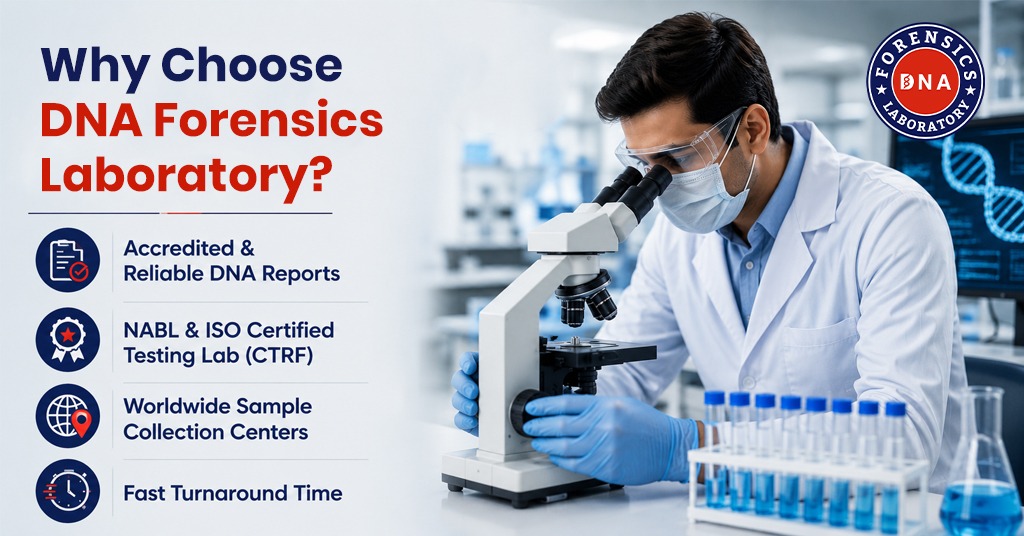
Why Choose DNA Forensics Laboratory for Paternity Test in India?
DNA Forensics Laboratory, also called DFL, is the only private DNA testing company in India whose DNA reports are legally admissible in the honorable courts. Here’s what sets us apart:
- Over 400 sample collection centers across the globe
- Testing lab, CTRF, is accredited by NABL, ISO 15189, and ILAC-MRA, ensuring the DNA results meet both national and international quality standards
- DNA tests for peace of mind, legal disputes, sponsored immigration, prenatal paternity, and more.
All your personal information and test results are kept strictly confidential. Your information is never shared with anyone outside of those involved in the test.
For more information or to book a paternity DNA test in India, call us at +91 8010177771. You can also send a message on WhatsApp at +91 9266615552.
Frequently Asked Questions
Q1. Is a paternity test legal in India?
Yes. It’s legal in India, and it’s even used in the honorable courts as evidence.
Q2. What documents are needed for a legal test?
You will need a government-issued ID, two passport-sized photographs, and a signed consent form.
Q3. How long does it take to get the results?
Standard results are delivered in 4 to 5 business days. Express delivery is available within 24 to 48 hours at an additional cost.
Q4. How accurate is a DNA paternity test?
A DNA paternity test is 99.99% accurate, making it reliable for both personal clarity and legal use.

